





















Thursday 27th November 2025
How dementia friendly is your church?
Sophie Duncan is an ordinand in the Diocese of Bristol and has recently completed an MA in practical theology at Sarum College, focusing on dementia and faith. Ahead of a speaking event with our partner charity Faith in Later Life, she explores how we can help make our churches places of welcome for those living with dementia

With nearly 950,000 people living with dementia in the UK, churches face a challenge: how to remain inclusive of those affected. Whilst many congregations aspire to be dementia friendly, the reality is that people living with dementia, as well as those who live alongside them, often become isolated from their church communities.
Dementia is an umbrella term for various conditions, the most common being Alzheimer’s. It’s not a natural part of ageing and affects individuals in diverse ways, including memory loss and difficulties with processing information. Media portrayals often reinforce negative stereotypes, but it is possible to live well with dementia.
Maintaining meaningful connections, especially within a faith community, can be profoundly beneficial. People living with dementia are cherished by God and are an important part of the body of Christ.
When a friend was diagnosed with dementia, she began to find church overwhelming and eventually stopped attending. Initially she remained connected through visits from church members, but over time these dwindled and eventually stopped — not from lack of love, but from uncertainty about how to engage. Many didn’t know how to interact with someone who might not recognise them, or didn’t appreciate the value of a visit that the person might not remember.
Therefore, being a dementia friendly church requires thoughtful changes in worship, pastoral care, and church activity. At its heart
is considering how people living with dementia can actively contribute to and be embraced by the church, and what this looks like as dementia progresses.
"Smiling, making eye contact, remembering names, all help."
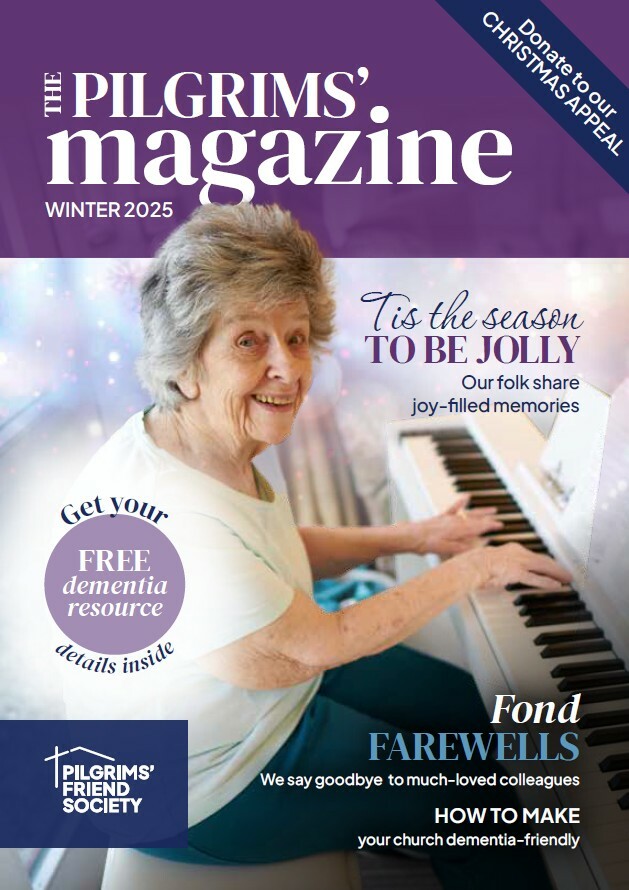
magazine
To receive your copy of the magazine FREE four times a year, sign up now.
A key part of being dementia friendly starts with the services. Getting the welcome right is a good start. Smiling, making eye contact, remembering names, all help. Try to avoid questions that rely on short-term memory, like “How was your week?” as these can be difficult to answer for someone living with dementia. Educating the congregation about dementia helps foster empathy. Having a “buddy” to sit with someone during services can offer comfort and support, both to the individual and their carer. It also allows carers to connect with others, knowing their loved one is cared for.
The physical environment matters too. Clear signage, contrasting toilet fixtures, accessible pathways, and strong safeguarding practices all contribute to a more navigable and safe space.
Services can be improved by using straightforward language; ensuring everything needed is included in one large print booklet; offering images or props to guide participants through the service; using familiar liturgy, such as the Lord’s Prayer; and including hymns familiar to those living with dementia. Consider if and how to talk about dementia in sermons and prayers, emphasising God’s love of people living with dementia, whilst not sanitising some of the hard realities. Providing space for lament and sorrow can be important, for example incorporating silence and music.
Avoid judging worship solely by visible responses. Presence and participation may take many forms. I’ve often seen people living with dementia participate, for example, by comforting someone else or joining in a hymn despite usually being non-verbal, but also know God is ministering in ways that we cannot see.
Helpful scaffolding can support someone to continue their ministry, for example, encouraging people to contribute to the prayers by offering examples to follow, or putting picture labels on the cupboard doors to help someone put away the coffee cups.
These are great ways to start becoming inclusive of people living with dementia — but church is more than services. To be dementia friendly means thinking holistically about how to support someone who isn’t present in services, ensuring they remain connected to church family.
Communication requires creativity and sensitivity. Rather than asking questions, engage in familiar topics and allow space for the person living with dementia to join in. Go with the flow of the conversation and listen to their views. Recognise that behind every expression is a need, which might not be immediately apparent, and respond with compassion.

Approach each interaction with wonder, expecting God to work through those living with dementia. Remember they are active members of the church, included by God. Notice when they’re absent and continue visiting even if they don’t remember your name. And don’t forget carers — they need love and support as they walk with a loved one with dementia.
The church is enriched by the inclusion of people living with dementia. Standing against the dominant societal narratives, the church affirms the value and humanity of all those who live with dementia. A dementia friendly church is not just accessible—it’s intentional, compassionate, and committed to seeing every person as a vital part of God’s family.
Sophie Duncan gave a webinar on this topic as part of Faith in Later Life’s regular programme for Church Champions on 22nd January 2026. For more great online events from Faith in Later Life, see here.
Get your FREE dementia resource...

We're giving away FREE copies of our resource Six Key Steps to Making a Dementia Inclusive Church. To request your copy, email info@pilgrimsfriend.org.uk and put 'Free dementia resource' in the subject heading. Alternatively, give us a call on 0300 303 1403.
More on tackling big issues in later life...

Offline connection
Alex Drew from our partner charity Faith in Later Life (FiLL) explores how to reach older people who aren’t online

Life after death
Alexandra Huggins from 'Faith in Later Life' shares how older adults can cope with bereavement and find support
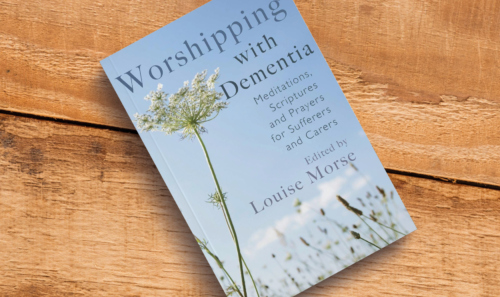
Worshipping With Dementia
For people with dementia, simplicity is paramount. These simple daily devotions are designed for use by caregivers, dementia sufferers, families, church groups, and medical professionals.