







Friday 21st November 2025
A legacy of care
As they bid us farewell, long serving staff members reflect on the changes they have seen over the years, what has made working here so special, and their hopes for the future
Barbara Margetts
Barbara Margetts joined Pilgrims’ Friend Society in 1999 as the manager of Framland, Wantage after working as a nurse in the NHS. She then became part of the Operations Team, supporting colleagues across the country as Assistant Director of Operations
“At the time I became a care home manager, there were a lot of changes in the sector, so I not only had to get to know the home but also get up to speed with all the new regulations. It was a lot to take in, but I always say the role brought together the three things I love: training and development, managing, and working with older people.

“Daily devotions were always a feature of life in our homes but one thing that has changed is our approach to the social life of the home. When I started at Framland, we had someone leading activities for a couple of hours each day. Now, we have a whole host of roles – Activities and Community Engagement (ACE) Facilitator, Hummingbird, Wellbeing and Dementia Lead – all dedicated to fostering connection.
“I think the difference is that people used to come into care homes much sooner and were more independent. Today, people come with a much higher level of need and need more support to engage. Carers also now have to give higher levels of care, so having staff whose sole focus is on fostering social interaction is important.
“Another big change has been the move from paper-based systems to a digital way of documenting information, as well as administering medications and auditing. There’s also now a whole suite of online training people can do.
“I love that I’ve been able to spend the past 26 years working with a Christian organisation and I pray that we never lose the central core of our Christian faith. I’m also praying that more people will know who we are and what we have to offer. I hope one day there will be a Pilgrims’ Friend Society care home in Wales, where I live. I know there are differences in funding and regulation, but there are other organisations that operate in England and Wales, so I know it’s not impossible.”

Louise Morse
Louise joined our organisation in 2000. Bringing a wealth of experience in journalism and marketing, she oversaw our publicity, spoke regularly at events and has authored several books, including many on dementia
“When I started, things were much more amateur than they are now. There was this tremendous swell of goodwill, with the Christian faith at its heart. At the executive level, there were people in place with a lot of talent and a high level of professional experience. But as far as the homes were concerned, there wasn’t much planning and looking forward. It was ‘as God provides’.
“However, a raft of legislation was brought in which made the sector increasingly regulated, and we had to respond to that. Responsibility for the homes, which had been managed locally, passed to the charity itself. I remember the then Chief Executive, Peter Turvet, giving a speech where he described adjusting to the regulations as being like driving a car down a country lane without being able to see over the hedge, or round the corner.
“Some of the homes had to close. At our home in Southport, for example, the area of each room did not meet the required specifications. It was also losing money hand over fist. The closure brought a lot of heartache but wonderfully all the residents found new homes, seven of them all together in another Christian home which happened to have seven free spaces. I wrote an article about it for this magazine.
“Through my talks and resources, I’ve also done a lot of work on helping those living with dementia and their caregivers. There’s now a much greater understanding of dementia, but the big question for individuals remains as it always was ‘what does this mean for me?’. I remember giving a talk once and afterwards there were 30 people lined up with questions all along the lines of ‘what does it mean when my mother does this?
“Going forward, I hope Pilgrims’ Friend Society will continue to speak to churches about dementia. People need to know that the person with dementia remains, they haven’t gone anywhere. It’s like, don’t talk to the brain, it’s not listening. Talk to the soul. “I’m also praying that God would continue to bring staff to our care home teams who have a real vocation. As one carer at Finborough Court [in Great Finborough] once said to me, great care isn’t so much person-centred but relational. It’s not just about one person but how you relate to each other.”

"It’s not just about one person but how you relate to each other."
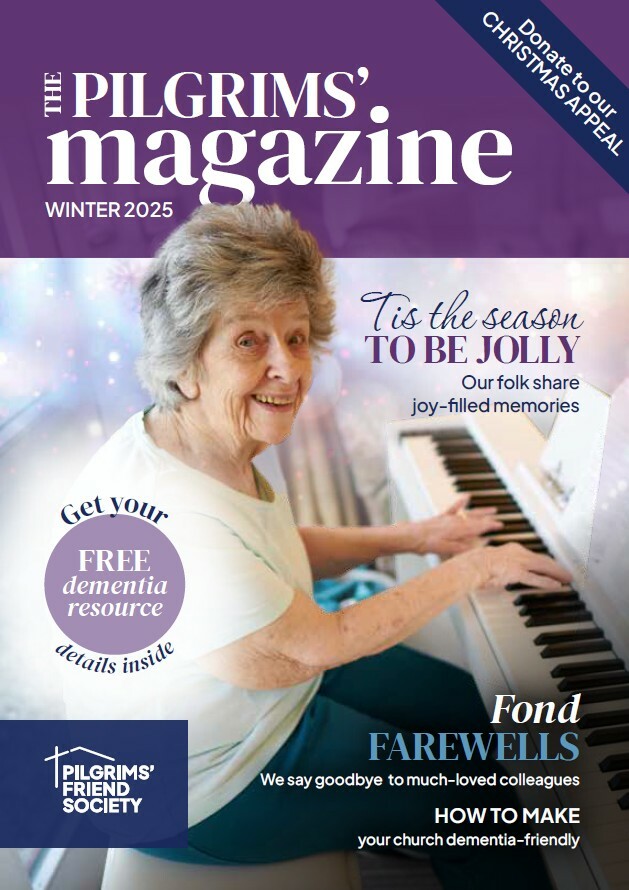
magazine
To receive your copy of the magazine FREE four times a year, sign up now.
Phil Wainwright
Phil joined us on 9th August 1993, a date that sticks in his mind as it was three days before the birth of his youngest son. Originally brought in as Systems and Payroll Officer, his role expanded to include HR and, for a time, aspects of publicity
“When I started it was to implement a computer system. There were four computers in the organisation at that time, all in Head Office [now known as the Support Office]. When computers were introduced at the homes, the main purpose was for word-processing. Before that, things like letters would be typed on typewriters. We didn’t have email (we had no internet), so we used fax machines to send each other memos. You were also on the phone a lot of the time.

At that time, the Chief Executive was Trevor Dennett. He was a lovely man and every Monday he phoned all the matrons to check how things were going. His wife Evelyn was the matron at Shottermill House in Haslemere and so I think he had a good understanding of the pressures of the role.
“Over the years things have changed a lot in terms of digitisation. We now use email all the time, interact via video calls and use AI to transcribe meetings. Our payroll system has also become much more integrated.
“I hope before too long the organisation will also have one centralised HR database. At the moment, staff at the homes are sometimes having to dig information out of paper files and that’s not ideal.
“There’s also been a lot of changes in how the homes are organised. When I started, we didn’t have managers. All the homes were run by matrons and they were all women. Lady Visitors used to come into the homes to give spiritual support. Shortly after I started, this title was changed to Home Visitors so that men could visit too. These days, we simply have volunteers.
"One thing that’s stayed the same in all the years I’ve been working for the charity is the commitment to prayer."
“One thing that’s stayed the same in all the years I’ve been working for the charity is the commitment to prayer. Early on, I was struck how every meeting begins with prayer. We’ve also always had a 12noon prayer meeting.
“Going forward, I hope that we continue to grow and build new homes. I’m always meeting people who say they wish there was a Pilgrims’ Friend Society home near them.”
Margaret Wetton
Margaret has been with us as Operations Manager since November 2017. It’s a role that’s taken her all around the country, and brought her into the company of some very special individuals
“When I joined Pilgrims’ Friend Society, I was instantly welcomed. It was like coming back to family, which is what it was, really. Everyone in senior leadership is a Christian, and so we’re all brothers and sisters in Christ.

“In my time, I’ve line-managed homes and housing schemes right across the country and, I’ll tell you what, my English geography has greatly improved. As the Operations Team, we’re really privileged to be able to do our work, not just to support the staff at the homes but to meet the ‘family members’ [as we call those who live us] and do things in the background that will make a difference to their lives.
“I remember one lady, Olive, who lives at Shottermill House in Haslemere. I used to love just sitting and listening to her and having lunch with her. A short time after the visit, I received a letter from what was then called the Head Office. I thought, ‘Why would I be getting something from Head Office?’ Inside the envelope, there was a letter forwarded from Olive to thank me for having lunch with her, and some poetry to finish with. It made me go, ‘That’s what makes the difference, that’s what makes it all worthwhile.’
“As a Christian organisation, it’s wonderful that we can all join together on a video call each day to pray. One day, I was leading the prayer time and shared something from Fanny Crosby, the hymnwriter who was blind. One of her phrases was ‘it’s not enough to have a song on your lips, you must also have a song in your heart.’ That’s what I feel about working with Pilgrims’ Friend Society – we’ve got God’s song in our heart.”
"That’s what I feel about working with Pilgrims’ Friend Society – we’ve got God’s song in our heart.”
As we were finalising our magazine, we received some exciting news...
While Margaret will be stepping back from her role as Operations Manager, she’ll be continuing to work with Pilgrims’ Friend Society supporting the Operations Team.
Please pray:
Thank you Barbara, Louise, Phil and Margaret for your years of dedicated service to Pilgrims’ Friend Society. May the Lord guide you in whatever comes next.
Find out more

Meet a Hummingbird...Lesley
For 12 years, Lesley has made Koinonia Christian Care Home, Worthing, her joyful calling
Meet a Manager...Timothy
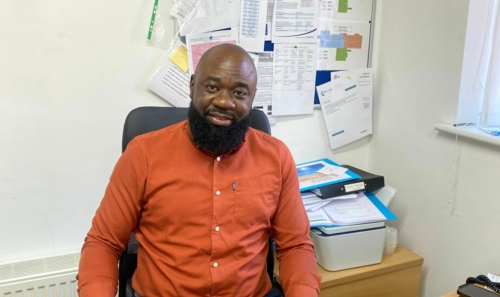
Registered Care Manager Timothy shares insights on leading Luff House and how the team supports individuals during the settling-in process

Meet a volunteer...Isabel
Isabel, 17, volunteers weekly at Milward House for her Duke of Edinburgh Award, building meaningful connections